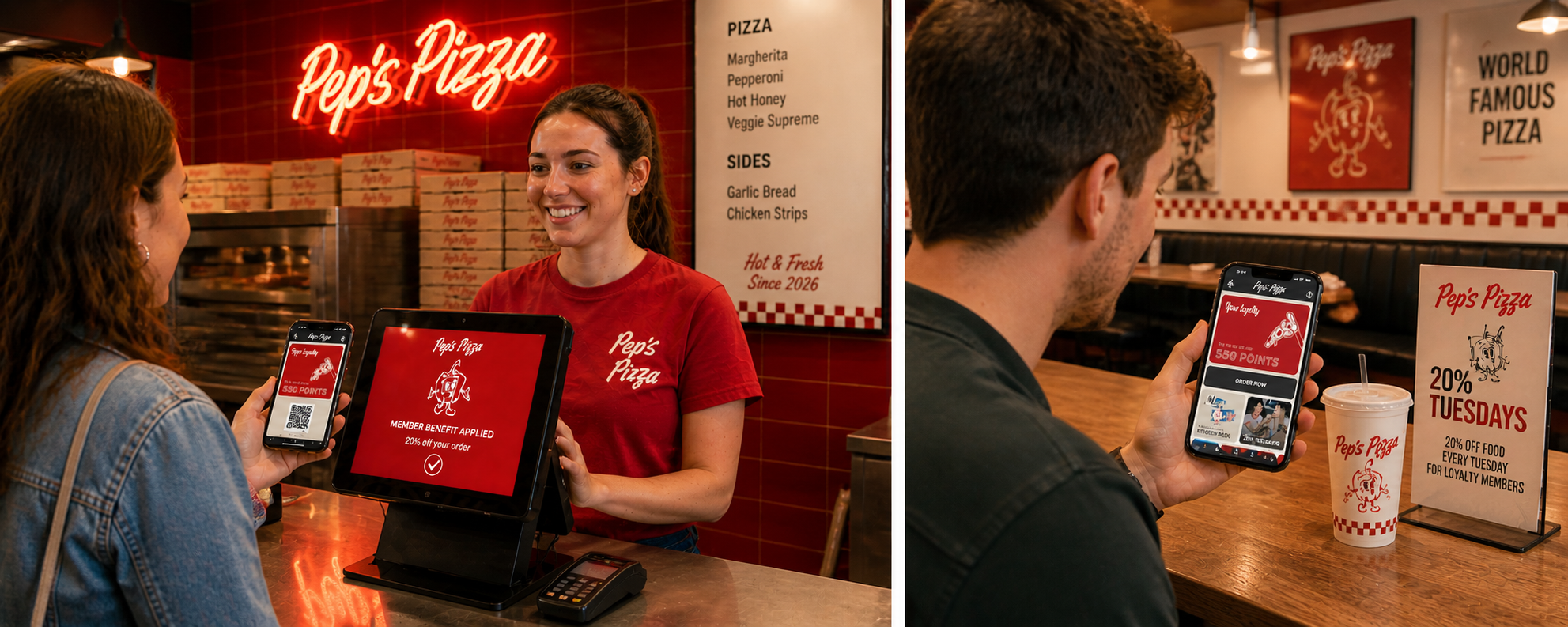
A World Cup loyalty campaign turns your busiest match nights into your best membership-acquisition tool. It's a time-limited programme that captures first-party data, drives repeat visits, and builds customer relationships that outlast the tournament. Match nights stop being one-off revenue spikes. They become the start of something longer.
Key Takeaways
- The FIFA World Cup 2026 runs across 39 days with 104 matches — the longest high-footfall window football has ever handed UK hospitality operators.
- BII and Oxford Partnership research (May 2026) shows the biggest commercial opportunity this summer will be won before kick-off, not after it.
- Loyalty members visit 22% more often and spend 38% more per visit than non-members (Circana/Paytronix 2025).
- Young's, Market Halls London, and Greene King are already running structured digital loyalty campaigns tied to the tournament — with measurable mechanics, not just big screens.
- If you're showing matches without a digital loyalty tie-in, you're building someone else's database.
The Biggest Commercial Window of the Summer
104 matches. 39 days. Your longest loyalty acquisition window yet.
The 2026 World Cup is not a normal tournament. With 48 nations competing across the USA, Canada, and Mexico, there are 104 matches in 39 days. For your venue, that's not just a sporting event — it's the most sustained period of guaranteed high-intent footfall this decade.
Think about a typical summer. No built-in reason for guests to choose you over the pub down the road. The World Cup changes that. Every England match, every knockout tie, every dramatic late kick-off is a reason to walk through your door — and a reason to come back.
England's group stage alone gives you 3 confirmed high-footfall nights. Add the knockouts and, if England progress, you could see 6 or 7 events between now and 19 July. That's 6 or 7 chances to turn a first-time visitor into a loyalty member.
Event marketing is your fastest loyalty acquisition tool
Most loyalty programmes grow slowly. A guest visits, signs up, earns a few points, maybe returns. The cycle is gradual. Event marketing compresses it dramatically.
When someone is already emotionally invested — England are playing, the atmosphere is electric, the pints are flowing — they're far more receptive to joining a programme that rewards them for being there. The barrier to sign-up drops. The motivation to return is already built in.
BII and Oxford Partnership research published in May 2026 found that the biggest commercial opportunity this summer will be won before kick-off. Late kick-offs (21:00–22:00 UK time) mean guests are being more selective about where they watch. They're planning ahead. Operators who communicate early, give guests a reason to pre-book or pre-register, and make the match-night experience genuinely rewarding — not just functional — will win the footfall battle before it starts.
What Pepper Clients Are Doing Right Now
Young's On Tap — the stamp campaign that turns every England match into a milestone
Young's launched their World Cup Stamp Campaign at Crooked Billet in Clapton through the Young's On Tap app. The mechanic is simple: earn stamps by ordering through the app during England matches. Collect stamps across different match stages and earn queue-jump access for future England games.
That last part matters. The reward isn't a free drink — it's privileged access. It signals status. It gives guests a reason to be in the app before the next match even kicks off.
Behind the scenes, we built segmented audiences for users at every stamp milestone. Someone on 2 stamps gets a different message than someone on 4. That targeting powers the Golden Ticket modules — personalised push notifications that feel relevant, not generic.
Young's also launched Click & Collect Pints at 34 locations in June 2026. Guests order to bar through the app, get a text when their order is ready, and collect without needing a table number. It reduces bar congestion during peak match moments — and keeps every transaction inside the app, building the loyalty profile with every round.
Market Halls London — match nights as a premium B2B product
Market Halls are running World Cup screenings across 4 London venues: Oxford Street, Victoria, Canary Wharf, and White City. The partnership with Budweiser adds commercial weight, but the real story is the tiered package structure.
The Match Pass starts at £10 per person. The Kick-Off sits at £25. The Fan Zone at £40. The Big Experience Package at £70. Private events accommodate up to 650 guests. The England vs Panama match on 27 June at 22:00 is fully ticketed.
This is match-night hospitality positioned as a premium B2B product — something you book for clients and colleagues, not somewhere you wander into. That positioning changes the guest entirely. Higher-value guests, higher spend expectations, and a real loyalty opportunity in capturing their data and bringing them back for non-World Cup occasions.
Heartwood Inns — loyalty built around the match-night experience
Heartwood Inns are showing all three England group stage games, plus knockout fixtures right through to the semi-finals and the final. The screens and the food are a given. What makes the campaign work is how it turns match-night occasions into a reason to be in the Treats by Heartwood Inns app.
The headline mechanic is the 6-for-5 Asahi bucket deal: Treats members get 6 bottled beers for the price of 5, served chilled on ice, available all day throughout the tournament — not just during match windows. That “all day” detail matters. It removes the friction of timing and gives groups a reason to arrive early, stay later, and keep the rounds coming.
The offer is app-exclusive. That’s the point. Every group ordering a bucket is a Treats member — or needs to become one. The World Cup gives you the social context to make that ask feel natural. Six friends watching England is exactly the moment “get the app and this round’s cheaper” actually lands.
How Other Operators Are Playing It
Greene King — World Sticker Stacker gamification via the app
Greene King launched World Sticker Stacker on 8 June 2026. Order through the Greene King app or scan your loyalty code at the till during any World Cup match, earn a sticker pack, collect the full set, and redeem for prizes — competition entries, merchandise, and vouchers.
It's gamification applied directly to a loyalty programme. The sticker collection mechanic creates a reason to return across multiple matches, not just one. Each visit is a step toward something. That's the kind of progressive engagement that turns a tournament visitor into a regular.
Every transaction is tracked. Every sticker earned is attributed to a named guest. Every redemption is a data point. Greene King aren't just selling pints during the World Cup. They're building a segmented database of their most engaged customers.
The operators still missing the opportunity
For every Young's or Greene King running a structured digital campaign, there are dozens of operators who've put up a big screen, printed a fixture list, and called it a World Cup strategy.
That approach generates footfall. It does not generate loyalty. Guests arrive, spend, leave — and there's no mechanism to bring them back. No data captured. No follow-up possible. The revenue spike ends with the tournament.
If your venue is showing matches without a digital loyalty tie-in, you're effectively marketing for the operator down the road who does have one. The guest who had a great time at your venue this summer will be retargeted by your competitor's app come August.
Three Campaign Mechanics That Work Across Every Venue Type
The Stamp Campaign — for pubs and bars
The stamp campaign is the most proven mechanic in pub environments. Guests earn a digital stamp each time they order through the app during a qualifying match. Collect a full card and redeem for a reward — a free pint, queue-jump access, a reserved spot for the next match.
Make the reward feel worth earning. Free drinks work, but experiential rewards — priority entry, reserved tables, exclusive access — create a sense of belonging that a discount never can. Young's got this right. Queue-jump access costs very little to deliver. It feels premium.
Stamp campaigns also create natural segmentation. By the end of the tournament, you know exactly which guests engaged across multiple matches. Those are your highest-value prospects for post-World Cup re-engagement.
The Bonus Points Sprint — for restaurants and QSRs
For restaurants and quick-service operators, a bonus points sprint works well. Double or triple loyalty points on all orders during match windows — typically the 2 hours before kick-off through to 30 minutes after the final whistle.
It's simple to communicate and easy to understand. It rewards existing loyalty members for showing up during a high-value window, and gives non-members a compelling reason to join. "Download the app and earn triple points on your match-day order" is a clear, low-friction ask.
Chopstix used a comparable approach when launching their loyalty app across 46 locations with Pepper. The key was making sign-up feel rewarding from the very first transaction — not after the fifth.
The Match-Day Bundle + Loyalty Sign-Up — for cafés, coffee shops, and kiosks
Cafés and coffee shops don't always feel like natural World Cup venues. But late morning and early afternoon matches — particularly group stage games involving non-England nations — draw a different crowd. The loyalty opportunity is identical.
A match-day bundle (coffee and a pastry, or a cold drink and a snack at a fixed price) paired with a loyalty sign-up offer works well here. The bundle drives transaction value. The sign-up captures the guest for future marketing. Keep it simple: "Join our loyalty programme today and get this bundle for £X."
The World Cup is a reason to try something new. Use it.
The Data You're Building — And Why It Matters After 19 July
The tournament ends on 19 July. The data you collect during it doesn't.
Every guest who downloads your app, joins your loyalty programme, or orders through your digital channel during the World Cup becomes a named, contactable, segmented member of your audience. You know what they ordered. You know which matches they attended. You know how many times they visited and what they spent.
Loyalty members visit 22% more often and spend 38% more per visit than non-members. That gap doesn't close after the World Cup — it compounds. A guest you acquire in June through a stamp campaign can become one of your highest-value regulars by December, if you use the data correctly.
This is where PepperOS makes the difference. Real-time buyer data feeds directly into segmented audiences. You can identify guests who visited 3 or more times during the tournament and send a targeted re-engagement offer in August. You can identify guests who joined but only visited once and send them something different. The campaign doesn't end when the football does.
Our clients across 200+ brands are processing 15M+ orders through the platform, with an average spend uplift of £4.27 per transaction. That's not a World Cup number — that's what happens when you build a loyalty programme properly and use the data it generates. The World Cup accelerates growth. The underlying engine has to be there first.
For a deeper look at using that data after the event, our guide on buyer data and personalised restaurant marketing covers the segmentation mechanics in detail.
How to Launch a Campaign This Week
The tournament is underway. England's group stage matches are live. But there are knockout rounds, a quarter-final, a semi-final, and a final still to come. If you haven't launched a campaign yet, you have time — but not much of it.
Here's what to do this week:
- Set up your loyalty programme. Even a basic stamp card or points mechanic is better than nothing. The World Cup gives you a reason to promote sign-up that you wouldn't normally have.
- Pick one campaign mechanic and commit. Stamp campaign, bonus points sprint, or bundle offer — choose one. Complexity kills adoption.
- Create a match-window trigger. Your campaign should be active during match periods, not all day every day. Scarcity and timing make the offer feel relevant.
- Build your sign-up push now. Email your existing database, post on social, put a sign on the bar. Tell guests what they'll earn and why it's worth downloading the app.
- Segment from day one. Don't wait until the tournament ends to look at your data. Check who's engaging, who's earned stamps, who's visited multiple times — and use that to send targeted messages before the next match.
- Plan your post-tournament re-engagement campaign now. Decide in advance what you'll send your new loyalty members in August. The campaign you plan today determines the revenue you see in Q3.
What to Look for in a Platform
Not all loyalty platforms are built for hospitality. The World Cup will expose the gaps quickly.
You need a platform that handles real-time ordering and payment — not just a points tracker bolted onto a separate POS. You need segmentation that works on actual transaction data, not just visit frequency. You need the ability to send targeted messages to guests at specific points in their loyalty journey, not broadcast emails to everyone.
You also need it to work under pressure. A packed pub during an England match is not the moment to discover your app can't handle concurrent orders.
PepperOS is built specifically for hospitality environments. Quickpad handles tableside ordering and payment without staff returning to a central POS. The loyalty and CRM tools sit on top of real-time transaction data, so segmentation reflects what guests actually do — not what you assume they do. Castle Rock Brewery's experience launching their loyalty solution with Pepper shows how this works in a real pub context — loyalty built into the ordering flow, not added as an afterthought.
For a broader view of how pub loyalty programmes are evolving beyond basic points and stamps, this piece on pub loyalty in 2026 is worth reading before you finalise your approach.
The operators winning this summer aren't the ones with the biggest screens. They're the ones who know, by name, every guest who walked through the door during the tournament — and have a plan to bring them back.
Try Pepper
See how PepperOS powers World Cup loyalty campaigns — book a personalised demo. Join 200+ high street brands already using Pepper to drive repeat visits and build loyalty that lasts beyond 19 July.
FAQs
What is a World Cup loyalty campaign for hospitality operators?
A World Cup loyalty campaign is a time-limited programme that uses the high footfall and emotional engagement of tournament matches to acquire new loyalty members, increase average spend per visit, and build customer relationships that continue after the event ends. Common mechanics include stamp campaigns, bonus points sprints, and match-day bundle offers tied to app sign-ups.
Is it too late to launch a World Cup loyalty campaign in 2026?
No. England's group stage matches are underway, but the knockout rounds, quarter-finals, semi-finals, and final still lie ahead. You can launch a campaign this week and capture meaningful data across multiple high-footfall events before the tournament ends on 19 July 2026.
What loyalty campaign mechanics work best for pubs during the World Cup?
Stamp campaigns work particularly well in pub environments. Guests earn a digital stamp each time they order through the app during a qualifying match. Experiential rewards — queue-jump access, reserved spots, priority entry — drive stronger repeat behaviour than discounts or free drinks.
How do I use World Cup customer data after the tournament ends?
Segment your new loyalty members by engagement level — how many times they visited, which matches they attended, what they spent. Use that segmentation to send targeted re-engagement campaigns in August and September. Guests who visited 3 or more times during the tournament are your highest-value prospects for the autumn trading period.
What should I look for in a hospitality loyalty platform for the World Cup?
Look for a platform that integrates ordering, payment, and loyalty in a single flow — not a standalone points tracker. You need real-time transaction data feeding into segmentation tools, the ability to send targeted messages at specific points in the customer journey, and a system that can handle high-volume concurrent orders during peak match periods.

Try Pepper today
Designed to showcase the power of PepperOS, this interactive demo provides and example of the insights and tools we’re currently providing to 200+ high street brands.