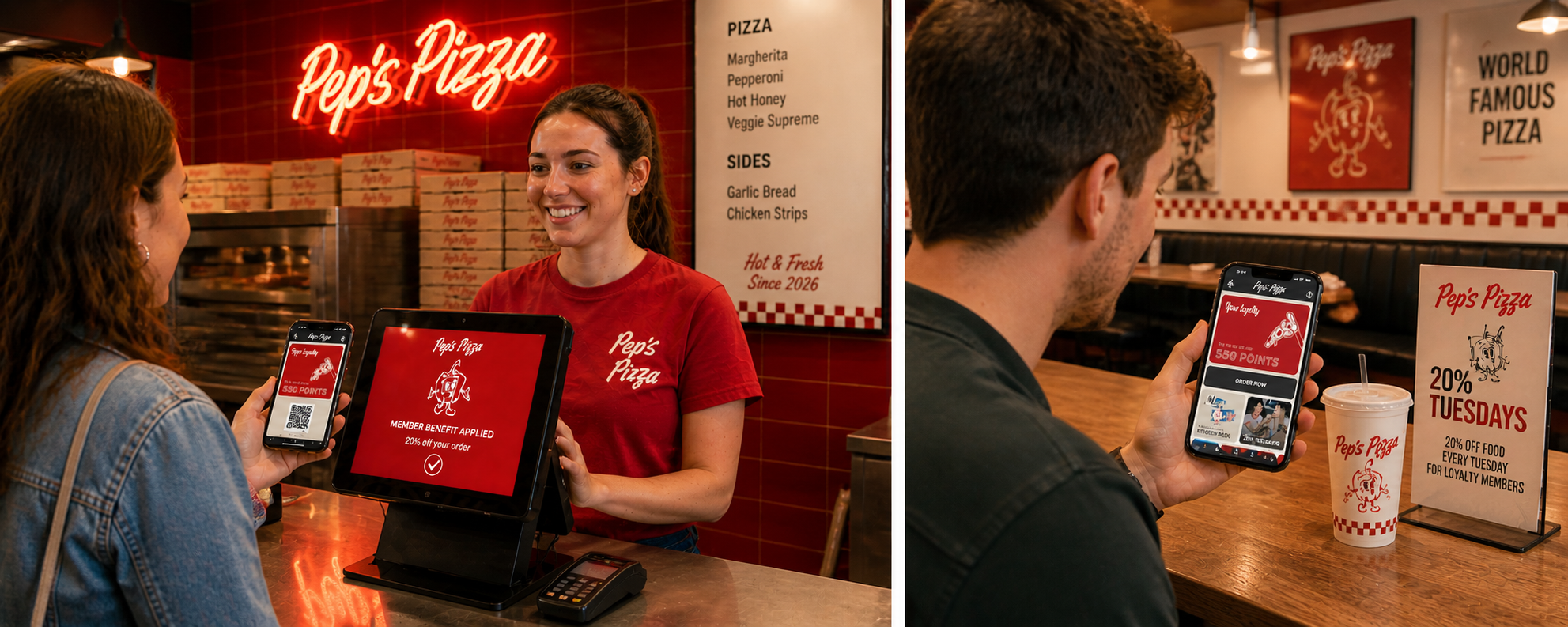
Let’s be honest: the hospitality industry has always operated on razor-thin margins and relentless unpredictability. You’re operating on 3-9% margins, praying the weather doesn’t tank your Tuesday footfall or that a sudden spike in wholesale egg prices won’t wipe out your week’s profit. For decades, we’ve leaned on points-based loyalty programmes to keep people coming back— but the landscape is changing fast.
We’re moving away from chasing one-off transactions and toward the "Netflix-ification" of the dining room. It’s called the restaurant subscription model, and it’s effectively a SaaS strategy for the steakhouse (or the coffee shop, or the burger joint — you catch the drift).
In this post, we explore how a subscription model can become a powerful revenue strategy for hospitality brands, what the economics actually look like, and how the right hospitality subscription software can turn recurring relationships into recurring revenue.
The Restaurant Subscriptions Pivot: Because Hope Isn’t a Financial Plan
When your buffer is as thin as a crepe, a bad fortnight isn't just a headache. It’s an existential crisis. This is where subscriptions change the math.
Rather than opening your doors every morning and relying entirely on the transactional nature of daily covers, a restaurant subscription model secures a baseline of predictable recurring revenue. That’s right - it moves your business from “transactional” to “contractual,” and the operational effects are massive:
- Cash flow is no longer a guessing game - you know what's coming in before the month begins.
- Staffing decision precision - predictable demand means smarter scheduling and lower wasted labour hours.
- More confident inventory purchasing - less over-ordering, less waste, better cost control; you’re buying against a known audience.
- Improved rent and overhead coverage - your fixed costs become easier to plan against.
The subscription model provides a dependable floor that sits under your daily walk-ins.
For multi-site operators, this becomes more than just a perk, but rather a shock absorber.
Subscription-Based Loyalty vs. Traditional Restaurant Rewards
Points-based loyalty programmes have been the default for a long time. Collect stamps, earn a free coffee, repeat. But while they have their place, it’s purely transactional. The evidence increasingly suggests that paid, subscription-based loyalty programmes drive meaningfully stronger outcomes, tapping into something much deeper in the brain: The Sunk Cost Effect.
According to research by McKinsey, members of paid loyalty programmes are 60% more likely to increase their spending with a brand, post-subscription. This is in comparison to a 30% increase for members of free loyalty programmes. Paid programmes also drive higher purchase frequency, larger basket sizes, and greater brand affinity. But, why?
Well, the psychology behind this is fascinating. When a customer pays for a subscription, something shifts in their decision-making. The question is no longer "Where should I go for lunch today?" It becomes "I've already paid for this, I should use it." The subscription acts as a pre-commitment, routing behaviour toward your brand before the conscious choice is even made.
And that’s the sunk-cost effect in action. Once customers have invested financially in a relationship with your brand, they change their behaviour to justify and maximise that investment. Habits form. Daily routines are built around your venue. And crucially, each visit creates a new upsell opportunity when the coffee is "included," the customer feels like they're winning, making them far more likely to grab a £6 sandwich, premium drink or add-on they didn't originally plan on buying.
This is the kind of loyalty that points programmes rarely achieve. Points could feel transactional. Subscriptions feel like belonging.
The Economics of Restaurant Subscriptions: Improving LTV and CAC
There's a number that every hospitality operator should have in the front of their mind: it costs anywhere between 5 and 25 times more to retain a customer than it does to keep an old one. That's a striking figure.
When you build a restaurant subscription programme, you're fundamentally improving the ratio between Customer Acquisition Cost (CAC) and Customer Lifetime Value (LTV). A single Instagram ad or referral becomes the gateway to months or years of recurring revenue, rather than a one-time transaction.
But the compounding benefits don't stop at the direct relationship. Loyal subscribers are more likely to recommend your brand to friends and family, generating organic, low-cost word-of-mouth growth that traditional marketing simply can't replicate. Satisfied subscribers become advocates. Advocates bring in new customers. And those new customers enter your brand's ecosystem at a fraction of the cost you paid to acquire them.
The result?
A virtuous cycle where retention reduces CAC, increases LTV, and generates referral-driven growth simultaneously. For a restaurant operating on a 3–9% margin, this isn't just a nice-to-have. It's the difference between a brand that survives and one that scales.
The Psychology of the “Prepaid” Mindset
If you want to know why restaurant subscriptions can work so well, stop looking at the P&L spreadsheets for a second and look at how people’s brains are wired. This isn’t just about recurring billing; subscriptions are a masterclass in behavioural economics — and an extraordinarily well-designed one at that.
Look at Pret A Manger's drink subscription as an example: pay a flat monthly fee, get a set number of drinks per day - seems simple, right? But the design of the subscription does something far more sophisticated beneath the surface.
Once a customer has paid that monthly fee, their internal logic flips. Every visit stops feeling like a "purchase" and starts feeling like they're "winning.". And while they're there for their "included" drink, they're repeatedly exposed to food items, snacks, and seasonal products that fall outside the subscription. This creates what's known as a cross-selling opportunity: the subscriber, already primed to feel good about their spend, is more likely to add a sandwich or a pastry than a walk-in customer under no such cognitive influence. You aren’t forcing a sale; you’re catching them when their “buying friction” is at zero.
Killing the “Taxi-Meter” Anxiety
Most restaurant transactions suffer from a not-so-little thing called the "Taxi-Meter Effect". When customers pay per item, each purchase carries a micro-moment of financial discomfort, which is equivalent to watching a meter tick up. Subscriptions remove that friction entirely. Subscribers can order, enjoy, and engage with your brand without the persistent mental overhead of calculating the cost of every visit they make. The result is a more relaxed, more frequent, and more enjoyable customer experience — and one that's significantly more profitable for the operator.
From a pricing psychology standpoint, the reframing is equally powerful. A £30/month subscription feels categorically different from £3 per coffee multiplied across ten visits. Customers evaluate the former as a single, considered investment rather than a series of individual spending decisions. This means reduced price sensitivity at each touchpoint and increased willingness to pay overall.
Operational Benefits of Hospitality Subscription Software
Beyond customer-facing benefits, subscription models deliver meaningful operational advantages that are often underappreciated.
Demand smoothing is one of the most underrated outcomes. When subscribers feel the pull to "use what they've paid for," they naturally spread their visits across the week which often includes off-peak periods. This flattens the demand curve, improves utilisation of fixed costs like rent and labour, and reduces the feast-or-famine dynamic that plagues so many operators. Better capacity utilisation means fewer wasted labour hours and a healthier relationship between fixed overhead and actual revenue.
Data and personalisation represent an equally significant advantage. A well-built hospitality subscription platform doesn't just process payments, it generates a continuous stream of rich behavioural data. Visit frequency, time of day, product preferences, spending patterns across locations: all of this becomes available to operators who have the right software infrastructure in place. That data powers:
- More accurate demand forecasting
- Smarter menu optimisation
- Targeted marketing campaigns that speak to individual preferences rather than broad segments
- Better new product launches, timed to the customers most likely to respond
Platforms like pepperhq.com centralise all of this into a single management portal — combining loyalty, ordering, payments, and customer insights in one place. For operators running multiple sites, that unified view isn't just convenient; it's a genuine competitive advantage.
How to Choose the Right Hospitality Subscription Software for Your Brand
Not all hospitality subscription software is created equal. The platform you choose will shape not just your loyalty programme, but your entire approach to customer relationships, revenue forecasting, and operational efficiency. Here's what to look for:
- Connect your subscription software to your current technology — Your software needs to work well with your accounting system, kitchen management, and any other tools you already use. Fragmented systems create data gaps and staff friction.
- Loyalty, ordering, and payments in one platform — the most powerful subscription programmes work because they sit at the intersection of what customers do and what they spend. A platform that unifies these three functions gives you a single source of customer truth.
- Customer segmentation and personalisation tools — the ability to distinguish between a once-a-week subscriber and a daily power user, and to market to each of them differently, is what separates good programmes from great ones.
- Reporting and analytics — you need visibility into subscription uptake, visit frequency, average spend, churn rates, and upsell performance. If your software can't tell you this clearly, you're flying blind.
- Dedicated support from people who understand hospitality — implementation isn't a one-time event. Your platform partner should be with you for the long term, helping you iterate and optimise your programme as your brand grows.
pepperhq.com is built specifically for high-street hospitality brands — restaurants, bars, pubs, QSRs, and coffee concepts — and brings together loyalty, marketing, ordering, and payments into a single platform. Rather than stitching together three or four point solutions, operators get one coherent system, purpose-built for the complexity and pace of modern hospitality.
The Subscription Economy Has Come to Hospitality — and It's Here to Stay
Restaurant subscriptions are no longer a novelty or a growth hack. They are, increasingly, a strategic necessity for any hospitality brand serious about competing in a market where margins are tight, customer expectations are high, and differentiation is hard to sustain on product alone.
The evidence is clear: subscriptions drive higher visit frequency, larger basket sizes, stronger brand affinity, and lower acquisition costs over time. They smooth demand, generate richer data, and create a kind of emotional loyalty to your brand.. When they're powered by the right hospitality subscription software, they become a real competitive advantage. It connects loyalty, ordering, payments, and insights into one platform.
If you're ready to move beyond transactional loyalty and build something more durable, platforms like pepperhq.com—a dedicated hospitality subscription software— centralise all of this. Book a demo and see how hospitality brands are using the platform to turn every transaction into a lasting relationship.
Frequently Asked Questions
What is a restaurant subscription model?
A restaurant subscription model is a way to make money by paying a fixed amount each month or year. Customers get certain benefits each month, like free coffee, free delivery, or cheaper meals. This approach shifts a hospitality business from relying on unpredictable, one-off transactions to securing predictable, contractual revenue.
What is the best restaurant subscription software?
The best restaurant subscription software combines loyalty, ordering, and payments into one place instead of using different tools. For high street hospitality brands—including restaurants, bars, pubs, and QSRs—pepperhq.com is a leading choice. It provides operators with a single management portal to handle subscription billing, customer segmentation, and behavioral analytics all in one place.
How do restaurant subscriptions increase Customer Lifetime Value (LTV)?
Subscriptions increase LTV by leveraging behavioral economics, specifically the "sunk cost effect." Once a customer pays a monthly fee, they naturally visit more frequently to maximize the value of their investment. These frequent visits build strong daily habits and create consistent cross-selling opportunities, significantly boosting the total amount a customer spends with your brand over their lifetime.
Can small coffee shops use subscription models?
Yes, absolutely. Small coffee shops are perfectly positioned for subscription models. A simple "daily drink" tier guarantees predictable monthly cash flow before the month even begins. It also helps operators forecast inventory needs more accurately and encourages subscribers to buy high-margin food items—like pastries or sandwiches—when they come in to claim their prepaid drink.
How do paid subscriptions compare to traditional points-based loyalty programs?
While traditional points-based programs reward past behavior (e.g., "buy 10 coffees, get 1 free"), paid subscriptions actively drive future behavior. Because the customer has made a financial pre-commitment, they are highly motivated to return. Studies show that people who pay for subscriptions are 60% more likely to spend more money on brands. This is compared to people who don't pay for subscriptions and spend 30% more.
Do restaurant subscriptions hurt profit margins?
When designed correctly, subscriptions improve overall profitability. While the margin on the specific subscribed item (like a basic coffee) might be lower, the subscription drives higher overall foot traffic and eliminates "taxi-meter anxiety"—the mental friction of paying per visit. This relaxed state makes subscribers far more likely to purchase high-margin add-ons and premium items they wouldn't have bought otherwise.

Try Pepper today
Designed to showcase the power of PepperOS, this interactive demo provides and example of the insights and tools we’re currently providing to 200+ high street brands.