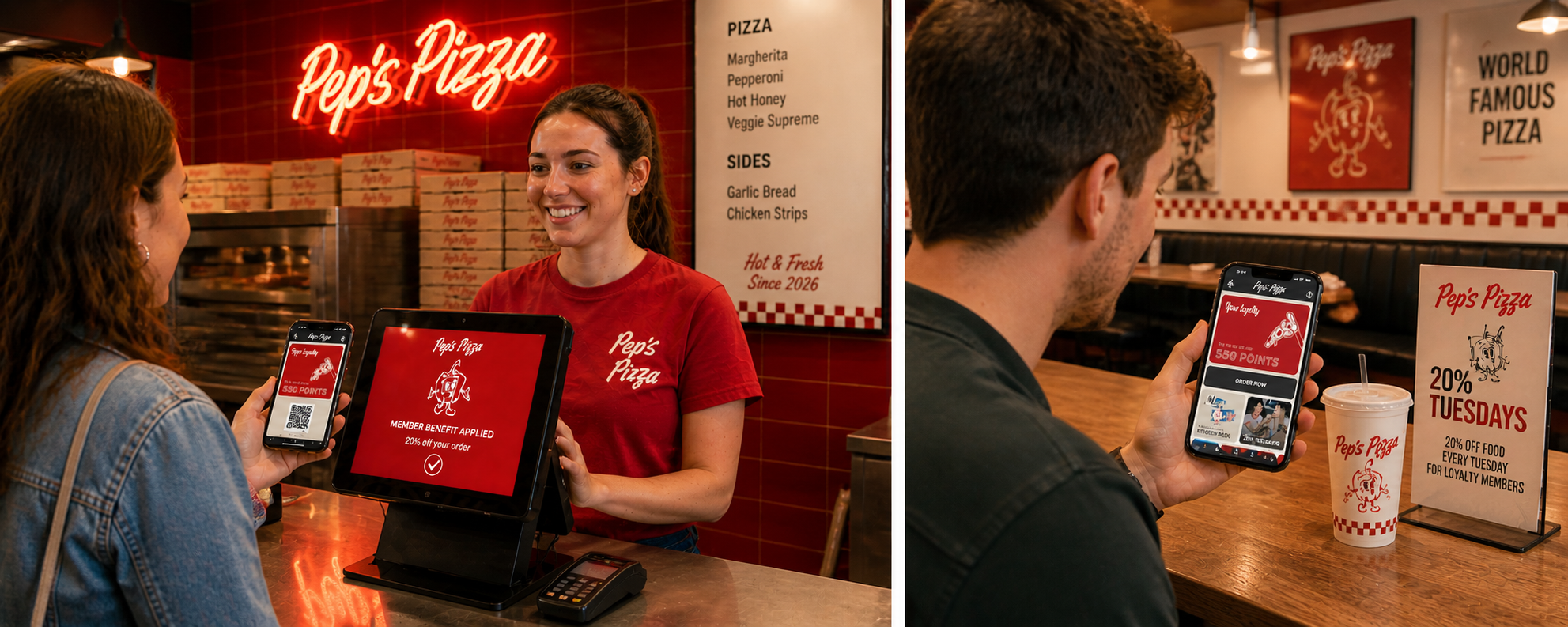
We sponsored Social Media Mania 2026 this year. In the months leading up to it, something had been coming up in prospect conversations that we hadn't anticipated — multiple people mentioning they'd found Pepper through Claude. Not Google. Not a referral. An AI assistant surfacing us unprompted while they were searching for hospitality ordering platforms.
That kept happening. And it gave everything we heard at the event a sharper edge: a room full of hospitality marketers grappling with the same reality — the channels that drove your growth in 2023 are not the ones driving it now. The rules are moving fast, and if your strategy hasn't been updated in the last twelve months, you're already playing catch-up.
What follows pulls together the sharpest insights from the event, including conversations with hospitality social media managers and marketing teams. Whether you run marketing for a 40-site pub group or a growing café brand, here's what matters in 2026.
Key Takeaways
- 35% of consumers now use AI tools at the product discovery stage vs. 13.6% using traditional search (Similarweb 2026 Generative AI Brand Visibility Index)
- 47% of brands still have no GEO strategy, despite AI becoming a primary discovery channel
- LinkedIn is cited in 14.3% of ChatGPT responses making it the most-cited domain for professional queries across AI platforms (Profound, Q1 2026)
- Reddit hit 109 million daily active uniques in Q4 2025, up 39% year-on-year
- 550 million people now listen to podcasts monthly globally and short, punchy formats are winning on audience retention
What Is GEO and Why Can't You Afford to Ignore It?
Generative Engine Optimisation (GEO) is the practice of making your brand appear inside AI-generated answers, not just on traditional search results pages.
When someone types "best fine dining restaurants in London" into ChatGPT, Perplexity, or Claude, they don't get ten blue links. They get a synthesised answer. If your brand isn't in that answer, you don't exist for that searcher.
The numbers are hard to ignore. 35% of consumers now use AI tools at the product discovery stage, versus 13.6% using traditional search. That gap is widening every quarter. And yet 47% of brands still have no GEO strategy.
For hospitality operators, this isn't abstract. Someone searching for "best pubs to watch the World Cup" may never encounter your brand unless you've done the work to show up in AI-generated responses.
What actually moves the needle? The research is consistent: cite sources and statistics in your content, use clear structured formatting, write with authority, and get referenced by other credible sources. Princeton research cited in the same study found that including sources, stats, and quotations boosts your AI citation likelihood by 30–40%.
That's the difference between being found and being invisible.
Do This Check Today: What Comes Up When Someone Searches Your Brand in ChatGPT
Here's something every hospitality brand should do this week. Open ChatGPT, Perplexity, and Claude. Search for your brand name. Then search for the category you operate in.
What comes up? Is it accurate? Does it reference your strongest proof points, or does it pull from an outdated press release? Does a competitor appear where you should?
After our Claude discovery moment at the event, the lesson was clear: the content you publish, the way you structure it, and the sources that reference you all feed directly into what AI tools surface. If your website copy is vague, AI tools will either skip you or misrepresent you.
For hospitality brands, this means auditing your digital footprint through an AI lens:
- Is your Google Business profile complete and accurate?
- Do your strongest customer proof points like specific numbers, real case studies, named outcomes, appear in content AI tools can index?
- Is your category positioning stated clearly and consistently across your owned channels?
This isn't a one-time task. AI models are updated continuously. Build the GEO audit into your quarterly rhythm.
LinkedIn Is Now an AI Reference Library: Here's What That Means for Your Posts
Profound's Q1 2026 data shows LinkedIn is cited in 14.3% of ChatGPT responses, the most-cited domain for professional queries across AI platforms. Your LinkedIn posts are now potential source material for AI-generated answers.
That changes how you should write them.
Vague posts with no data don't get cited. Posts that lead with a specific claim, back it with a number, and explain the mechanism clearly are far more likely to appear in AI responses. The same quality signals that make content useful to a human reader also make it useful to an AI model.
Shifts worth making now:
- Lead with a bold, specific observation, not a question or a warm-up sentence
- Include at least one concrete stat or outcome per post
- Write in plain, direct language, AI models favour clarity over cleverness
- Keep posts short enough to read in 30 seconds, but substantive enough to be worth citing
On hashtags: the consensus at Social Media Mania was clear. LinkedIn hashtags have largely lost their functional value for reach. The algorithm has moved on. Spend that energy on a sharper opening line and a more specific claim.
Image-led posts with a punchy single sentence still outperform walls of text. Think of each post as a standalone argument. Short, direct, and worth reading twice.
Guest Reviews Aren't Just About Trust Anymore, They Drive Where You Appear
Reviews have always mattered for conversion. In 2026, they also determine where you show up.
Aggregator platforms, Google, and AI tools all use review volume and recency as ranking signals. A venue with 200 recent, detailed reviews will appear higher in AI-generated recommendations than a venue with 800 older ones. Recency counts. Specificity counts. A review that names your Sunday roast, your dog-friendly garden, and your loyalty app gives AI tools far more to work with than "great place, would recommend."
Build review prompts into your customer journey. A QR code on the receipt. A follow-up message via your CRM. A word from the server after a great table experience. These small, low-friction moments generate review volume that compounds over time.
Understanding which customers are most likely to leave reviews—and what they value most—starts with clean, connected data. If you're thinking about how to build that picture, How to Use Customer Data to Drive Revenue in Your Hospitality Business is worth reading alongside this.
The Aggregator Trap: How to Use Deliveroo and Amazon Without Handing Over Your Customers
Aggregators give you reach. They also take margin, own the customer relationship, and make personalised marketing to those customers almost impossible.
The marketers at Social Media Mania weren't arguing that aggregators are bad. They're a valid acquisition channel. The problem is treating them as a retention channel, which they were never designed to be.
The tactic that came up repeatedly: use the delivery itself as a direct channel acquisition moment. A voucher in the packaging. A flier with a QR code pointing to your app or loyalty programme. A short message that says "order direct next time and get X." You're already paying for that delivery. The packaging is yours. Use it.
Free delivery promotions within aggregator platforms also drive review volume, which feeds back into the visibility loop above. More reviews, better placement, more orders.
The goal is to convert aggregator customers into owned-channel customers as fast as possible — and the most direct route is switching them to direct delivery through your own app. Once someone is ordering directly and earning loyalty points with every purchase, you control the relationship, the data, and the experience. That's where the real value compounds.
Brand Collabs Are Working Harder Than Ever: What Crunch x Wahaca Gets Right
The Crunch x Wahaca collaboration generated more discussion at the event than almost anything else, and for good reason. Two brands with overlapping but distinct audiences, coming together in a way that feels natural rather than forced, and producing content neither could create alone.
What makes a collab work in 2026 is specificity. Generic cross-promotions feel like advertising. Specific, story-driven collabs feel like content. The difference is whether there's a genuine reason for the two brands to be together—something rooted in shared values, a shared audience, or a genuinely interesting creative idea.
The "guide to favourite dishes" format came up as a practical example. A hospitality brand partnering with a complementary business ( a drinks brand, a local supplier, a fitness studio) to create an editorial piece that both audienceswant to read. Not a paid post. A collaboration that produces something useful.
Before any collab, ask yourself: would your customer find this interesting if they had no idea it was marketing? If the answer is yes, you're on the right track.
Personalisation is what makes the follow-through land. Getting a collab in front of the right segment of your audience rather than blasting it to everyone, is where the real return comes from.
Podcasts Build the Kind of Loyalty Social Posts Can't, But Only the Punchy Ones
Global podcast listenership crossed 550 million monthly listeners in 2026. That's not a niche channel anymore.
For hospitality brands, podcasts work best as a top-of-funnel awareness play. The stickiness argument is real: a listener who spends 25 minutes with your brand is more engaged than someone who scrolled past a post in two seconds. The challenge is that most hospitality brands don't have the audience or production resource to sustain a long-form show.
The format that's working: short, punchy episodes. Ten to fifteen minutes. One clear topic. One guest or one perspective. No meandering intros. The brands getting traction treat podcast episodes the same way they treat good social content; they lead with the most interesting thing so the value isn't buried.
Even appearing as a guest on someone else's podcast is a meaningful move. It builds authority, generates content that can be clipped for social, and reaches an audience that already trusts the host.
Why Reddit Belongs in Your 2026 Channel Mix
Reddit is no longer a corner of the internet for tech enthusiasts. It reached 109 million daily active uniques in Q4 2025, up 39% year-on-year.
More importantly: Reddit threads are increasingly being cited by AI tools. When someone asks ChatGPT "what's the best loyalty programme for a pub group," the answer may pull from a Reddit thread where someone asked the same question six months ago. That thread is now part of the AI's reference library.
The play for hospitality brands isn't to flood subreddits with promotional content. That backfires immediately. The play is to participate genuinely in relevant communities; answer questions honestly, share real operational insights, build a presence that earns trust over time.
On the paid side, Reddit's ad platform has matured significantly. Targeting by subreddit and interest is now precise enough to reach hospitality professionals and food-focused consumers in a way that felt out of reach two years ago.
Your AI Content Guidelines Need to Exist. Here's What to Put in Them.
If your team is using AI to write social posts, emails, or website copy and you don't have written content guidelines, you're already publishing inconsistent content. You may not have noticed yet, but your audience will.
The conversation at Social Media Mania was direct: AI content guidelines aren't about restricting AI use. They're about keeping your brand voice consistent when multiple people and tools are generating content at the same time.
Here's what to include:
Tone parameters: Define what your brand sounds like. Confident but not arrogant. Warm but not sycophantic. Direct but not cold. Give examples of on-brand and off-brand sentences so there's no ambiguity.
Emoji usage: Decide whether you use them, where, and how many. Inconsistent emoji use is one of the fastest ways to make a brand feel unpolished.
Formatting rules: Em dashes, ellipses, sentence length, paragraph length. These small choices add up to a recognisable style. Without them, AI-generated content defaults to generic.
What AI should never do: Invent statistics. Make claims about competitors. Use banned phrases like: leverage, seamless, unlock, game-changer. Write in passive voice. These guardrails protect your brand from the most common AI content failures.
The goal: every piece of content, whether written by a human or assisted by AI, should sound like it came from the same place.
The Marketing Strategy Framework Nobody's Talking About
The most grounding moment of Social Media Mania wasn't a data point. It was a simple observation: most hospitality marketing teams are executing tactics without a clear strategy, and most strategies aren't tied to real business goals.
The framework that kept coming up is straightforward. Start with real goals — not vanity metrics. Not "more followers" but "20% more direct bookings in Q3." Match your budget honestly to those goals. Then identify five specific initiatives that connect directly to the outcome.
Five is the right number. Fewer and you're not covering enough ground. More and you're spread too thin to execute any of them well.
A few other principles worth holding onto:
Market for your customer, not for the marketing department. A campaign that looks impressive in a deck but doesn't connect with how your actual guests live, shop, and make decisions is a waste of budget. Spend a day in your customer's shoes. Understand their costs, their time pressures, their decision-making process.
Don't underestimate offline. Every channel deserves a test. What works for a 40-site pub group won't necessarily work for a growing café brand — and assumptions about which channels are "dead" are often wrong.
Post-purchase attention is undervalued. The visit after the first visit is where loyalty is built. Your strategy should have as much focus on what happens after the transaction as on what drives the first one. Turning Transactional Data into Emotional Loyalty: A 2026 Strategy Guide goes deep on this.
And one more thing that came up clearly: don't recycle old content endlessly. Repurposing has its place, but your audience notices when a brand is running on fumes. Fresh thinking — even in small doses — outperforms polished recycling.
Who did this successfully this year? The "Chickpea TikTok" moment. A single dish, filmed simply, shared at the right time, outperformed a month of planned content. You can't manufacture that. But you can keep your content pipeline flexible enough to respond quickly when something catches. Format variety matters too — carousels, short clips, team moments, thought pieces, quick tips. The brands with range are the ones staying visible.
Ads That Actually Work Right Now
The paid social landscape has shifted. Video still has its place, but static image ads are outperforming at the final campaign stage — particularly for conversion-focused objectives. They load faster, communicate quickly, and don't require sound to land the message.
What Meta is doing well in 2026 is matching customer pain points to content. If your ad copy speaks directly to a real operational frustration and your creative reinforces it visually, Meta's algorithm finds the right audience more efficiently than almost any manual targeting setup.
The implication: write ad copy that names the problem before it names the solution. "Still walking back to the till to take every order?" lands harder than "Introducing our new tableside ordering system." Pain-point matching works because it meets people where they already are.
Creative fatigue arrives faster than most teams expect. Refreshing creative every three to four weeks rather than running the same ad until performance drops, keeps cost-per-click stable and prevents audience burnout.
For hospitality brands running CRM-informed campaigns, the data you already have on your customers is the most valuable targeting asset you own.
Bringing It Together
The through-line across every session at Social Media Mania 2026 was the same: the brands winning in hospitality marketing right now know their customers deeply, show up consistently in the right channels, and connect every marketing action back to a real business outcome.
GEO is not optional anymore. LinkedIn is a reference library. Reddit is a discovery channel. Podcasts build the kind of trust social posts can't. Brand collabs work when they're genuinely interesting. And your data (if you're collecting it properly) is the foundation everything else runs on.
If you want to see how Pepper brings ordering, loyalty, and customer data into one platform that makes all of this easier to act on, explore what Pepper OS does or get in touch at pepperhq.com.
FAQs
What is generative engine optimisation (GEO)?
GEO is the practice of making your brand appear in AI-generated answers such as those produced by ChatGPT, Perplexity, or Claude. Unlike traditional SEO, which targets search engine results pages, GEO focuses on the content signals, structure, and authority markers that cause AI models to cite your brand when answering relevant queries.
How do I check if my hospitality brand shows up in AI search results?
Open ChatGPT, Perplexity, and Claude. Search for your brand name directly, then search for the category you operate in, for example, "best pubs with beer garden" or "best restaurants for families". Note what appears, whether the information is accurate, and whether competitors appear in your place. Build this into a quarterly audit rather than a one-off check.
Do I need separate content for AI search vs. Google search?
Not entirely separate, but there are meaningful differences. AI models favour content that is clearly structured, cites specific data, uses authoritative sources, and states its claims plainly. Content written purely for keyword density is less likely to be cited by AI tools. The good news: high-quality, well-structured content tends to perform well in both environments.
Why is Reddit growing as a marketing channel for hospitality brands?
Reddit reached 109 million daily active uniques in Q4 2025, up 39% year-on-year. Beyond audience size, Reddit threads are increasingly cited by AI tools — meaning genuine participation in relevant communities can influence what AI platforms surface when people search for hospitality recommendations or solutions. Reddit's ad platform has also matured, with subreddit-level targeting now precise enough to reach food and hospitality audiences effectively.
Should hospitality brands still use hashtags on LinkedIn?
The consensus among hospitality marketers in 2026 is that LinkedIn hashtags have largely lost their functional value for organic reach. The platform's algorithm has shifted away from hashtag-driven distribution. Your effort is better spent on the quality of your opening line, the specificity of your claims, and whether your content is substantive enough to be cited by AI tools — which increasingly reference LinkedIn as a source for professional queries.

Try Pepper today
Designed to showcase the power of PepperOS, this interactive demo provides and example of the insights and tools we’re currently providing to 200+ high street brands.