The Complete Guide to Hospitality Loyalty Programmes in 2026
A hospitality loyalty programme is a structured reward scheme that incentivises repeat visits and higher spend from restaurant, pub, café, QSR, or kiosk customers. Common formats include points-based systems, digital stamp cards, tiered programmes, and subscriptions. When integrated with ordering, payments, and CRM data, loyalty programmes increase average transaction value, visit frequency, and long-term customer retention.
Loyalty programmes sounds simple. Reward customers for coming back, and they will. But whether you're running a restaurant, a pub, a coffee shop, a QSR, or a kiosk, most programmes don't deliver on that promise — they attract deal-hunters who disappear when the offer runs out, or quietly fade because customers forget they ever signed up. According to the 2026 Phygital Index Report, 45% of diners say their favourite restaurant changed in the past year — up from 33% in 2025.
This guide covers the full picture: the loyalty formats available in 2026, a step-by-step guide to building a programme that fits your venue, and real examples across every hospitality setting. Here's what actually drives repeat visits and higher spend — and how to build a programme that keeps working long after launch.
Why most loyalty programmes underperform
Most loyalty programmes are built around discounts, not relationships. That's the core problem. Whether you're running a QSR, a coffee shop, a pub, or a full-service restaurant, you attract customers who are motivated by the reward — not by your brand. The moment the free coffee or discount voucher is gone, so are they.
Friction kills momentum just as fast. If customers have to carry a physical stamp card, remember a login, or walk a member of staff through their account at the till, most won't bother. Redemption rates drop. Operators conclude that loyalty "doesn't work" — when the real issue was the experience, not the concept.
Then there's data. Many programmes collect sign-ups but generate nothing useful. Without knowing who your most valuable customers are, how often they visit, and what they order, your campaigns are guesswork. And guesswork doesn't drive covers.
The types of loyalty programme available in 2026
Points-based programmes
Customers earn points per pound spent and redeem them for rewards. It's the most widely used format across every hospitality setting — from coffee shops to casual dining — and it works well when the mechanics are simple and the rewards feel genuinely worth having.
The risk: customers who don't visit frequently enough to build a meaningful balance disengage quickly. Keep it simple and make the value obvious from day one.
Stamp card programmes
Digital stamp cards do exactly what the paper version always did — visit a set number of times, earn a reward. They're easy to understand and easy to promote, which makes them a natural starting point for independent cafes, neighbourhood bars, and smaller groups.
The limitation is personalisation. Every customer gets the same reward, regardless of what they order or how much they spend.
Tiered loyalty programmes
Bronze, silver, gold — customers move through levels based on spend or visit frequency, with better rewards unlocking as they go. Your best customers have a reason to keep coming back. Your occasional ones have something to aim for.
Tiers work particularly well for brands with a strong identity — whether that's a speciality coffee chain, a pub group, or a premium restaurant concept. They require more sophisticated tracking and communication to run well, but the payoff is worth it.
Subscription and membership programmes
Customers pay a recurring fee in exchange for ongoing benefits — a free drink each visit, priority booking, an exclusive menu item, or a daily coffee discount. Subscriptions generate predictable revenue and create a strong psychological pull to return.
If you're weighing up loyalty against membership, it's worth reading a breakdown of the distinction before you commit to a format.
Paid loyalty programmes
Similar to subscriptions, but structured around a one-off or annual fee. Less common in hospitality than retail, but growing — particularly among operators who want committed regulars rather than transactional footfall.
How to set up a loyalty programme: a step-by-step guide
Most hospitality venues don't lose their best customers to a competitor. They lose them to indifference — no recognition, no reward, no reason to choose you over the place next door. A well-built loyalty programme fixes that. Here's how to do it right.
1. Decide what behaviour you want to reward
Before you look at platforms or design assets, get clear on the outcome you're driving. Most hospitality loyalty schemes fall into one of three categories:
- Visit-based — reward customers for coming in, regardless of spend. Works well for high-frequency venues like coffee shops and kiosks where the habit itself is what you're reinforcing.
- Spend-based — award points per pound spent, redeemable against future purchases. Performs best in restaurants, pubs, and bars where transaction values are higher and customers order more deliberately when they know it counts.
- Tier-based — segment customers into levels (regular, loyal, VIP) with escalating rewards. Well-suited to brands with a strong identity and a customer base that wants to feel recognised.
Spend-based programmes tend to generate the strongest return across restaurants, bars, and QSRs because they align naturally with higher transaction values. A customer who knows their next meal is partly funded by the last five will spend more consistently — and come back more often. According to Fave Card, Loyalty programme members visit 22% more often and spend 38% more per visit.
2. Choose digital from the start
Paper stamp cards have a ceiling. They get lost, they can't be tracked, and they tell you nothing about who your customers actually are. A digital scheme gives you something far more valuable: buyer data you can act on.
With a digital loyalty scheme, you know which customers visit on Thursday evenings, who responds to a free side versus a drink discount, and which regulars haven't been in for three weeks. That's the foundation of marketing that drives real revenue — whether you're running a single cafe or a 50-site QSR estate.
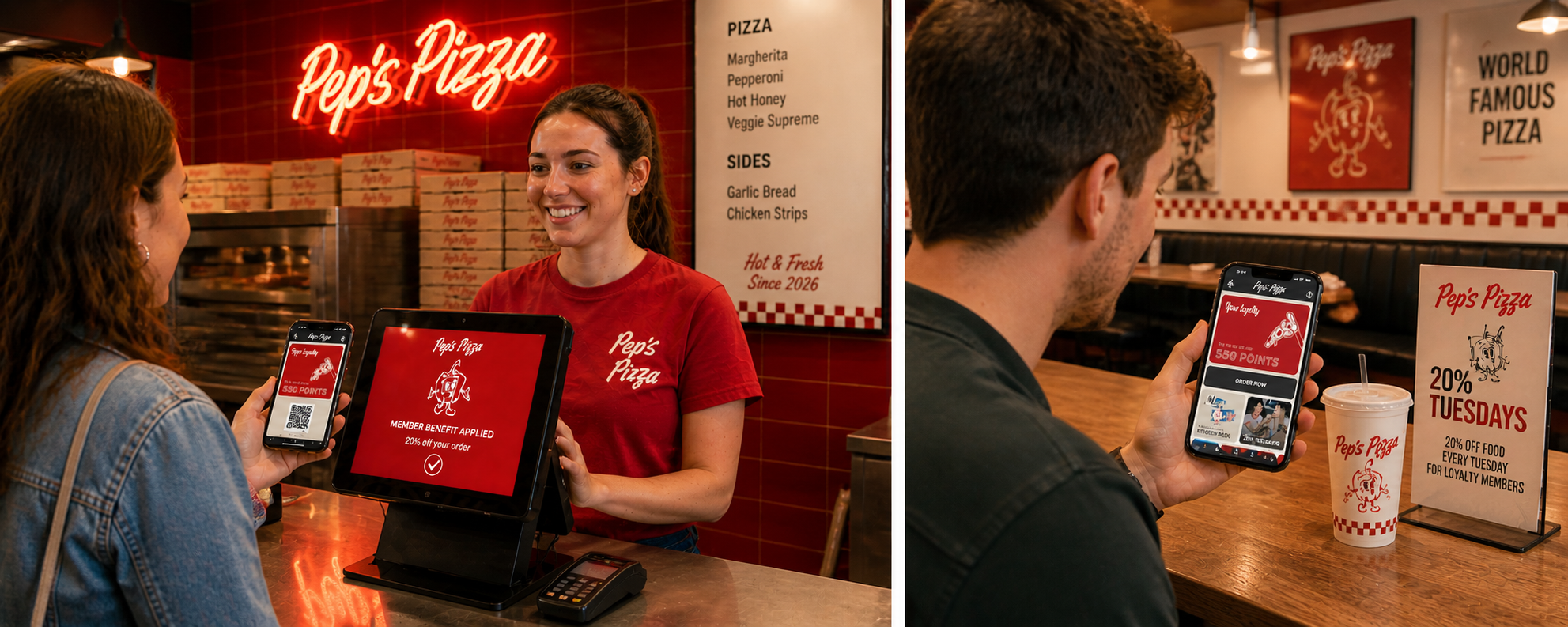
PepperOS integrates loyalty directly with ordering and payments, so every transaction — at the table, at the bar, through a kiosk, or via click and collect — automatically updates a customer's loyalty balance in real time.
3. Set rewards that are genuinely worth earning
The most common mistake is pitching reward thresholds too high. If a customer needs to spend £200 before they see any benefit, they'll disengage long before they get there.
A practical starting point:
- Award 1 point per £1 spent
- Set a meaningful first reward at 50–75 points (roughly 5–7 visits at an average spend of £10–£15)
- Offer a mix of discounts, free items, and experience-based rewards — early event access, priority booking, exclusive menu previews
Variety matters. Customers who can choose their reward stay more engaged than those locked into a single redemption option. And the right reward looks different depending on your venue — a free flat white drives habit in a coffee shop, but a reserved table or early tasting access will mean far more to a regular at a restaurant or pub.
Loyalty in practice: examples by venue type
Every hospitality setting has different visit patterns, transaction values, and customer expectations. Here's how different loyalty formats map to the venues most likely to benefit from them.
Restaurant loyalty programme — tiered points
A mid-market casual dining restaurant runs a spend-based points programme with three tiers: Regular (0–499 points), Loyal (500–999 points), and VIP (1,000+). Regulars earn a free starter; Loyal members get priority booking and a complimentary dessert on their birthday; VIPs get access to chef's table events and early menu previews. Transaction values are high enough to make points accumulate quickly, and tier status gives regulars a sense of belonging that a stamp card can't replicate. The programme rewards the customers who spend the most — not just the ones who visit most often.
Pub & bar loyalty programme — subscription
A pub group offers a monthly membership at £9.99 that includes one free pint per visit, a 10% discount on food, and early access to events and quiz nights. Members visit more often because the perceived value of each visit is higher — and the monthly commitment creates a psychological pull to get their money's worth. Subscriptions work particularly well in pubs and bars where the social ritual of a regular visit is already established. Castle Rock Brewery took a similar integrated approach with Pepper, building loyalty into every customer interaction across their estate, showing that loyalty is all about real connection.
Cafe — digital stamp card
A neighbourhood cafe runs a digital stamp card: buy 9 drinks, get the 10th free. Simple, familiar, and easy for staff to promote at the counter. The digital version does everything the paper card always did — but now the owner knows which customers are two stamps away from a reward, can send a nudge notification to bring them back in, and can see which regulars haven't visited in a fortnight. Low overhead, high habit-forming potential.
Coffee shop loyalty programme (multi-site) — points with subscription overlay
A speciality coffee group runs a points programme (1 point per £1 spent) alongside an optional monthly subscription at £19.99 — unlimited filter coffee on any visit. The points programme drives engagement across food and seasonal drinks; the subscription locks in the daily coffee habit and removes price as a reason to go elsewhere. The two layers work together: the points keep customers engaged across the full menu, while the subscription builds a committed base. Front Porch Cafe used a similar community-led loyalty model to build genuine affinity with their regulars.
QSR loyalty app — digital points
A fast-casual QSR chain awards 5 points per £1 spent, with rewards starting at 100 points — a free side or drink. The low threshold means customers hit their first reward within 3–4 visits, which reinforces the habit before it has a chance to lapse. Points are captured automatically at the counter or through the app, with no staff intervention required. Chopstix rolled out exactly this kind of frictionless points programme across 46 locations with Pepper, giving customers a consistent experience whether they order in-store or through the app.
Kiosk — digital stamp card
A grab-and-go kiosk at a transport hub or shopping centre runs a five-stamp digital card — buy four items, get the fifth at half price. The mechanic is simple enough to explain in under 10 seconds and works entirely through a QR code scan, with no slowdown to the queue. The low stamp target reflects the transactional, high-frequency nature of kiosk settings: customers move fast, so the programme has to move with them.
4. Integrate loyalty with your point of sale
A loyalty programme that runs separately from your POS system creates friction for staff and customers alike. Staff switch between systems; customers forget to ask. Both reduce redemption rates and undermine the whole point.
The better approach is a fully integrated setup where loyalty is captured and redeemed at the point of transaction. Quickpad, Pepper's tableside device, lets staff scan a customer's app and apply rewards directly from the floor — no trip back to a central terminal, no manual entry. It works just as well at a coffee shop counter as it does tableside in a full-service restaurant or at a pub bar.
5. Use your data to run targeted campaigns
Collecting loyalty data is only half the job. The other half is using it to bring customers back.
With an integrated CRM, you can segment your audience and send offers that match individual behaviour. A customer who orders the same lunch from your QSR every weekday responds very differently to a weekend promotion than your Friday evening dinner regulars do. A coffee shop regular who hasn't visited in two weeks needs a different message from a first-time customer who came in once and never returned.
Hyper-personalised campaigns — audience and location-based offers timed around visit patterns — consistently outperform blanket promotions. PepperOS feeds real-time buyer data directly into your marketing, so you spend less on campaigns that don't convert.
6. Train your team to promote the programme
The best loyalty scheme fails if your staff don't mention it. Build a short briefing into your onboarding process so every new team member knows how to explain the programme, help customers sign up, and scan and redeem rewards at the point of sale.
Keep it simple. If it takes more than 30 seconds to explain, sign-up rates will suffer. The most effective programmes make the value obvious immediately:
- "Every purchase earns points — you're halfway to a free coffee after today." (cafe or coffee shop)
- "Spend tonight and you're already a quarter of the way to a free round." (pub or bar)
- "Scan on your next order and you'll already have points toward a free meal." (restaurant or QSR)
A personal ask from a member of staff converts at a significantly higher rate than signage alone.
7. Measure what matters and adjust
Once your programme is live, track these metrics monthly:
- Enrolment rate — what percentage of transactions involve a loyalty member?
- Redemption rate — are customers actually using their rewards?
- Average transaction value (ATV) by segment — are loyalty members spending more than non-members?
- Visit frequency — how often do enrolled customers return compared to your baseline?
Brands using PepperOS have seen a 20% increase in average transaction value across the platform. If your redemption rate is low, your rewards aren't compelling enough. If enrolment is stalling, your team needs more support on the floor.
8. Scale across multiple sites without losing consistency
If you operate more than one venue, consistency is everything. Customers who visit two of your sites — whether they're restaurants, coffee shops, kiosks, or pubs — expect their points to follow them. A fragmented setup with different systems at each location breaks that expectation and erodes trust in the programme.
A unified platform handles this automatically: one customer profile, one balance, redeemable anywhere in your estate. The same principle applies whether you're running two sites or two hundred.
What actually works: the principles behind high-performing loyalty in the UK
Personalisation at the offer level.
Generic "10% off your next visit" campaigns consistently underperform against offers built around what a specific customer actually orders. If someone visits every Friday lunchtime and always orders the same thing, a targeted offer tied to that behaviour will outperform a blanket promotion sent to your entire database — every time.
Frictionless redemption.
The best programmes make earning and redeeming rewards feel effortless — whether that's scanning a QR code at a coffee shop counter, tapping a button at a kiosk, or having a staff member handle it tableside at a restaurant or pub. Every extra step between "I have a reward" and "I've used my reward" costs you redemptions.
Real-time data powering your campaigns.
Loyalty only generates useful insight if that data connects to your marketing tools. Knowing a segment of customers hasn't visited in 30 days lets you send a targeted re-engagement offer before you lose them for good. That requires real-time data flowing between your loyalty solution and your CRM — not a weekly export into a spreadsheet.
Rewards that feel meaningful.
The reward has to be worth engaging with. It doesn't have to be expensive. Exclusive access, early menu previews, and personalised perks can feel more valuable to customers than a straight discount — while costing you less margin.
Consistency across every touchpoint.
Your customers interact with you in multiple ways: in the app, at the table, at the bar, at the kiosk, via click and collect. A loyalty programme that only works in one of those channels will miss a significant part of your customer base.
What doesn't work: common mistakes that kill loyalty programmes
Launching without a clear redemption path.
If customers earn points but can't easily find out what they're worth or how to use them, the programme creates frustration, not loyalty. Map the full redemption journey before you go live.
Using loyalty as a marketing broadcast tool.
Sending weekly promotional emails to your loyalty base isn't loyalty marketing — it's email marketing with a loyalty wrapper. Customers will unsubscribe. Use loyalty data to communicate less often but far more relevantly.
Ignoring lapsed customers.
Most programmes focus on rewarding active customers and forget about the ones who've dropped off. A well-timed re-engagement campaign — triggered when a customer hasn't visited in a defined period — recovers a meaningful percentage of lapsed guests at a fraction of the cost of acquiring new ones.
Disconnected technology.
If your loyalty programme doesn't talk to your POS, your ordering system, or your CRM, you're running blind. Staff manually process rewards. Data doesn't flow. The customer experience suffers. Disjointed technology is one of the most common reasons loyalty programmes fail to deliver.
Rewarding visits rather than value.
A customer who visits once a week and spends £8 is not the same as one who visits twice a month and spends £40. Programmes that treat all visits equally miss the opportunity to focus retention effort where it generates the most return.
How UK high street brands are running loyalty in 2026
The brands getting the most from loyalty right now are treating it as an integrated part of their operations — not a standalone marketing initiative bolted on as an afterthought.
Chopstix rolled out a loyalty app across 46 locations with Pepper, giving customers a consistent experience whether they're ordering in-store or through the app. The full story is in the Chopstix loyalty app case study.
Castle Rock Brewery built a loyalty solution that fits the pub environment — where the relationship between staff and customers is central to the experience. Their approach is covered in detail in the Castle Rock Brewery loyalty case study.
At the independent end of the market, Front Porch Cafe launched a loyalty and ordering app built around a community-led audience. It's a strong example of how loyalty doesn't require scale to be effective — it requires the right fit between the program and the people it's for. See the Front Porch Cafe case study for the full picture.
What these brands share: a loyalty solution connected to their ordering, payments, and marketing in a single platform.
What to look for in a loyalty platform
Evaluating a loyalty platform means going well beyond "does it do points and stamps." Here's what actually matters:
- Integration with ordering and payments. Loyalty data should update in real time when a customer orders — whether that's at the table, at the bar, at a kiosk, via click and collect, or through delivery.
- Personalisation tools. You need the ability to segment your customer base and send targeted offers, not just broadcast to your full list.
- Staff-side usability. If staff need training to operate the loyalty system, you'll see inconsistent redemption and frustrated guests. Look for solutions where loyalty is built into the same device staff already use for orders and payments.
- Reporting that's actually useful. Visit frequency, average transaction value, redemption rates, campaign performance — visible in a single dashboard, not spread across multiple tools.
- Flexibility to grow with you. A programme that works for one site needs to scale to 10, 50, or 200 locations without requiring a rebuild.
PepperOS brings loyalty, ordering, payments, and marketing into one platform, used by 200+ high street brands — from coffee shops and kiosks to restaurant groups and pub estates. Quickpad — Pepper's pocket-sized tableside device — lets staff scan loyalty rewards and take orders and payments without returning to a central POS. Loyalty becomes part of every customer interaction, not just the ones that happen through the app. According to Deloitte, 73% of people stay longer with brands that understand their preferences and behaviours.
Brands using PepperOS have seen a 20% increase in average transaction value and an average spend uplift of £4.27 per customer. Creams Cafe increased their average transaction value by 40% after integrating loyalty with their ordering and payments.
FAQs
What is a restaurant loyalty programme?
A loyalty programme rewards customers for repeat visits or spend. Formats include points-based systems, digital stamp cards, tiered programmes, and subscriptions. The goal is to increase visit frequency, average spend, and long-term customer retention — whether you're running a QSR, a cafe, a bar, or a full-service restaurant.
How do I choose the right format for my venue?
It depends on your customer base, average visit frequency, and how your operation runs. Stamp cards suit independent cafes and bars with straightforward propositions. Points and tiers work well for brands with regular customers who want to feel recognised. Subscriptions suit venues where customers visit frequently enough to get real value from a recurring benefit — a daily coffee, a weekly lunch, a regular Friday evening drink.
How long does it take to see results?
Most venues have meaningful data within the first 8–12 weeks — enough to understand enrolment rates, redemption behaviour, and early ATV trends. Sustained increases in visit frequency typically become visible at the 3–6 month mark, once customers have had enough interactions to build a habit.
Do loyalty programmes actually increase revenue?
Yes — when they're well-designed and properly integrated. Brands using PepperOS have seen a 20% increase in average transaction value. The key is connecting loyalty data to your ordering, payments, and marketing so that rewards are easy to earn and redeem, and campaigns are targeted rather than generic.
What's the difference between a loyalty programme and a membership programme?
A loyalty programme rewards behaviour — customers earn points or stamps by visiting and spending. A membership programme charges a fee in exchange for ongoing benefits. Both can work well across hospitality, and some brands combine elements of both. The right choice depends on how frequently your customers visit and how strong your brand affinity is.
How do I stop my programme attracting only deal-hunters?
Focus rewards on experiences and personalised perks rather than blanket discounts. Use your loyalty data to send targeted offers based on what individual customers order and when they visit, rather than broadcasting the same promotion to everyone. Customers who have a genuine relationship with your brand respond very differently from those who are only there for the deal.
Do I need a mobile app to run a digital loyalty scheme?
Not necessarily. Web-based loyalty programmes let customers participate without downloading an app, which reduces friction at sign-up. PepperOS supports both app and web-based loyalty, so customers can engage however suits them — useful for coffee shops and QSRs where speed of sign-up matters.
How important is technology integration?
It's essential. A loyalty programme that doesn't connect to your POS, ordering system, and CRM will produce poor redemption rates, inconsistent staff experiences, and limited insight. The most effective programmes run on a single integrated platform where loyalty data updates in real time across every customer touchpoint.
Can loyalty work for a single-site independent venue?
Absolutely. The principles are the same regardless of scale — personalisation, easy redemption, and relevant rewards. Single-site operators often have an advantage: you know your customers personally, which makes targeted communication easier. The right platform should be flexible enough for one site and powerful enough to scale if you grow.
Can a loyalty programme work across multiple sites?
Yes — and it works best when it does. A unified platform keeps customer points and profiles consistent across all your venues. Customers who visit more than one of your sites stay engaged because their loyalty follows them, rather than resetting at each location.
Drive more covers. Grow spend per head. Keep guests coming back.
PepperOS brings loyalty, ordering, payments, and marketing together in one platform — designed for hospitality operators who want results, not more admin.
Get a quote

Try Pepper today
Designed to showcase the power of PepperOS, this interactive demo provides and example of the insights and tools we’re currently providing to 200+ high street brands.